ALL BRANDS
The history of golf balls spans from early wooden balls to the modern, multi-layer synthetic ball. Key developments include the Feathery (17th century), a leather ball packed with goose feathers, followed by the more affordable and durable Gutty (mid-19th century), made from tree sap. The introduction of the Haskell rubber-core ball in 1898, coupled with the development of dimples around 1905, led to the modern golf ball design that minimizes drag and increases distance.
Early golf balls
Wooden balls: The earliest balls were likely simple wooden spheres, though definitive evidence is scarce.
Feathery balls (17th century): Handcrafted leather pouches were stuffed with wet goose or chicken feathers. As the feathers dried and expanded, they created a hard, resilient ball that could be hit up to 200 yards, but was ruined by water.
The Gutty and Haskell eras
Gutta-percha balls (1848): Also called "guttie" balls, these were made from the dried sap of a tropical tree. They were more affordable and durable than the feathery balls.
Haskell ball (1898): Inventor Coburn Haskell created the first rubber-core ball by winding rubber threads around a solid rubber center.
Dimples: Players discovered that scuffed and worn "guttie" balls flew farther. This led to the realization that an uneven surface, like the dimples first
introduced in 1905, created a layer of turbulence that reduced drag and increased flight distance.
Modern golf balls
Two-piece balls (1972): Spalding introduced the two-piece ball with a rubber core and plastic casing, a design that became standard for many amateur players due to its durability and distance.
Layered construction: Today's balls typically have a multi-layer construction with a solid core and a cover made of materials like urethane, which offer a balance of performance for all levels of play.
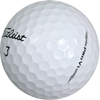
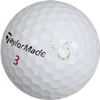
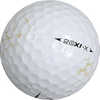
We offer different models of used ALL BRANDS golf balls in three different grades – mint-condition golf balls (AAAAA/5A), near-mint condition (AAAA/4A) and value-condition (AAA/3A). Golf ball performance tests show no appreciable difference in game performance between new and mint-quality ALL BRANDS golf balls. Read more.

CALLAWAY WARBIRD YELLOW
The Callaway Warbird is a golf ball from Callaway that was designed to provide maximum distance and optimal control for golfers. The Warbird is known for its distance off the tee and its soft feel around the greens. The ball's...

CALLAWAY WARBIRD
The Callaway Warbird is a golf ball from Callaway that was designed to provide maximum distance and optimal control for golfers. The Warbird is known for its distance off the tee and its soft feel around the greens. The ball's...
ALL BRANDS Models
- Show All
- BRIDGESTONE ALL
- BRIDGESTONE COLOR
- BRIDGESTONE E12
- BRIDGESTONE E12 SOFT
- BRIDGESTONE E6
- BRIDGESTONE E6 SOFT
- BRIDGESTONE E6 SPEED
- BRIDGESTONE E7
- BRIDGESTONE EXTRA SOFT
- BRIDGESTONE LADDIE
- BRIDGESTONE LADY
- BRIDGESTONE MIX
- BRIDGESTONE PRECEPT
- BRIDGESTONE TOUR B RX
- BRIDGESTONE TOUR B RXS
- BRIDGESTONE TOUR B X
- BRIDGESTONE TOUR B XS
- BRIDGESTONE TOUR B330
- BRIDGSTONE TOUR B RX
- CALLAWAY 360
- CALLAWAY ALL
- CALLAWAY CHROME
- CALLAWAY CHROME SOFT
- CALLAWAY CHROME SOFT X
- CALLAWAY CHROME TOUR
- CALLAWAY CHROME TOUR X
- CALLAWAY COLOR
- CALLAWAY DIABLO
- CALLAWAY ERC
- CALLAWAY HEX
- CALLAWAY MIX
- CALLAWAY REVA
- CALLAWAY SUPERFAST
- CALLAWAY SUPERHOT
- CALLAWAY SUPERSOFT
- CALLAWAY TRIPLE TRACK
- CALLAWAY TRUTRACK
- CALLAWAY TRUVIS
- CALLAWAY WARBIRD
- CLEAR
- CUT
- DIXON
- GOLF BALL COLORS
- GOLF BALL CRYSTAL
- GOLF BALL LADIES
- GOLF BALL MIX
- GOLF BALL ORANGE
- GOLF BALL PINK
- GOLF BALL YELLOW
- HOGAN
- KIRKLAND
- LED AND GLOW BALLS
- MAXFLI
- MG
- MIZUNO
- NIKE
- ONCORE
- PINNACLE
- POLARA
- PRECEPT LADDIE
- PRECEPT MIX
- SNELL
- SRIXON ALL
- SRIXON COLOR
- SRIXON MIX
- SRIXON Q STAR
- SRIXON Q STAR TOUR
- SRIXON SOFTFEEL
- SRIXON Z STAR
- SRIXON Z STAR DIVIDE
- SRIXON Z STAR XV
- TAYLORMADE ALL MODELS
- TAYLORMADE BURNER
- TAYLORMADE COLOR
- TAYLORMADE MIX
- TAYLORMADE NOODLE
- TAYLORMADE PENTA
- TAYLORMADE PROJECT A
- TAYLORMADE PROJECT S
- TAYLORMADE ROCKETBALLZ
- TAYLORMADE SOFT RESPONSE
- TAYLORMADE SPEEDSOFT
- TAYLORMADE TOUR RESPONSE
- TAYLORMADE TOUR RESPOSE
- TAYLORMADE TP5
- TAYLORMADE TP5X
- TITLEIST ALL
- TITLEIST AVX
- TITLEIST COLOR
- Titleist DT SOLO
- TITLEIST MIX
- TITLEIST NXT
- TITLEIST NXT TOUR
- TITLEIST NXT TOUR S
- TITLEIST PRO V1
- TITLEIST PRO V1 2018
- TITLEIST PRO V1 2020
- TITLEIST PRO V1 2021
- TITLEIST PRO V1 2023
- TITLEIST PRO V1 YELLOW
- TITLEIST PRO V1X
- TITLEIST PRO V1X 2020
- TITLEIST PRO V1X 2021
- TITLEIST TOUR SOFT
- TITLEIST TOUR SPEED
- TITLEIST TRUFEEL
- TITLEIST TRUSOFT
- TITLEIST VELOCITY
- TOP FLITE
- VICE
- VOLVIK
- WILSON