ALL BRANDS
The history of golf balls spans from early wooden balls to the modern, multi-layer synthetic ball. Key developments include the Feathery (17th century), a leather ball packed with goose feathers, followed by the more affordable and durable Gutty (mid-19th century), made from tree sap. The introduction of the Haskell rubber-core ball in 1898, coupled with the development of dimples around 1905, led to the modern golf ball design that minimizes drag and increases distance.
Early golf balls
Wooden balls: The earliest balls were likely simple wooden spheres, though definitive evidence is scarce.
Feathery balls (17th century): Handcrafted leather pouches were stuffed with wet goose or chicken feathers. As the feathers dried and expanded, they created a hard, resilient ball that could be hit up to 200 yards, but was ruined by water.
The Gutty and Haskell eras
Gutta-percha balls (1848): Also called "guttie" balls, these were made from the dried sap of a tropical tree. They were more affordable and durable than the feathery balls.
Haskell ball (1898): Inventor Coburn Haskell created the first rubber-core ball by winding rubber threads around a solid rubber center.
Dimples: Players discovered that scuffed and worn "guttie" balls flew farther. This led to the realization that an uneven surface, like the dimples first
introduced in 1905, created a layer of turbulence that reduced drag and increased flight distance.
Modern golf balls
Two-piece balls (1972): Spalding introduced the two-piece ball with a rubber core and plastic casing, a design that became standard for many amateur players due to its durability and distance.
Layered construction: Today's balls typically have a multi-layer construction with a solid core and a cover made of materials like urethane, which offer a balance of performance for all levels of play.
We offer different models of used ALL BRANDS golf balls in three different grades – mint-condition golf balls (AAAAA/5A), near-mint condition (AAAA/4A) and value-condition (AAA/3A). Golf ball performance tests show no appreciable difference in game performance between new and mint-quality ALL BRANDS golf balls. Read more.

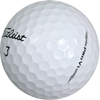
TITLEIST PRO V1 2020
The Titleist Pro V1 2020 golf ball offers a combination of speed, distance, and green side control with a soft feel. It is a multi-component, three-piece ball featuring a proprietary reformulated 2.0 ZG process core, a thinner urethane cover, and...
ALL BRANDS Models
- Show All
- BRIDGESTONE ALL
- BRIDGESTONE COLOR
- BRIDGESTONE E12
- BRIDGESTONE E12 SOFT
- BRIDGESTONE E6
- BRIDGESTONE E6 SOFT
- BRIDGESTONE E6 SPEED
- BRIDGESTONE E7
- BRIDGESTONE EXTRA SOFT
- BRIDGESTONE LADDIE
- BRIDGESTONE LADY
- BRIDGESTONE MIX
- BRIDGESTONE PRECEPT
- BRIDGESTONE TOUR B RX
- BRIDGESTONE TOUR B RXS
- BRIDGESTONE TOUR B X
- BRIDGESTONE TOUR B XS
- BRIDGESTONE TOUR B330
- BRIDGSTONE TOUR B RX
- CALLAWAY 360
- CALLAWAY ALL
- CALLAWAY CHROME
- CALLAWAY CHROME SOFT
- CALLAWAY CHROME SOFT X
- CALLAWAY CHROME TOUR
- CALLAWAY CHROME TOUR X
- CALLAWAY COLOR
- CALLAWAY DIABLO
- CALLAWAY ERC
- CALLAWAY HEX
- CALLAWAY MIX
- CALLAWAY REVA
- CALLAWAY SUPERFAST
- CALLAWAY SUPERHOT
- CALLAWAY SUPERSOFT
- CALLAWAY TRIPLE TRACK
- CALLAWAY TRUTRACK
- CALLAWAY TRUVIS
- CALLAWAY WARBIRD
- CLEAR
- CUT
- DIXON
- GOLF BALL COLORS
- GOLF BALL CRYSTAL
- GOLF BALL LADIES
- GOLF BALL MIX
- GOLF BALL ORANGE
- GOLF BALL PINK
- GOLF BALL YELLOW
- HOGAN
- KIRKLAND
- LED AND GLOW BALLS
- MAXFLI
- MG
- MIZUNO
- NIKE
- ONCORE
- PINNACLE
- POLARA
- PRECEPT LADDIE
- PRECEPT MIX
- SNELL
- SRIXON ALL
- SRIXON COLOR
- SRIXON MIX
- SRIXON Q STAR
- SRIXON Q STAR TOUR
- SRIXON SOFTFEEL
- SRIXON Z STAR
- SRIXON Z STAR DIVIDE
- SRIXON Z STAR XV
- TAYLORMADE ALL MODELS
- TAYLORMADE BURNER
- TAYLORMADE COLOR
- TAYLORMADE KALEA
- TAYLORMADE MIX
- TAYLORMADE NOODLE
- TAYLORMADE PENTA
- TAYLORMADE PROJECT A
- TAYLORMADE PROJECT S
- TAYLORMADE ROCKETBALLZ
- TAYLORMADE SOFT RESPONSE
- TAYLORMADE SPEEDSOFT
- TAYLORMADE TOUR RESPONSE
- TAYLORMADE TOUR RESPOSE
- TAYLORMADE TP5
- TAYLORMADE TP5X
- TITLEIST ALL
- TITLEIST AVX
- TITLEIST COLOR
- Titleist DT SOLO
- TITLEIST MIX
- TITLEIST NXT
- TITLEIST NXT TOUR
- TITLEIST NXT TOUR S
- TITLEIST PRO V1
- TITLEIST PRO V1 2018
- TITLEIST PRO V1 2020
- TITLEIST PRO V1 2021
- TITLEIST PRO V1 2023
- TITLEIST PRO V1 YELLOW
- TITLEIST PRO V1X
- TITLEIST PRO V1X 2020
- TITLEIST PRO V1X 2021
- TITLEIST TOUR SOFT
- TITLEIST TOUR SPEED
- TITLEIST TRUFEEL
- TITLEIST TRUSOFT
- TITLEIST VELOCITY
- TOP FLITE
- VICE
- VOLVIK
- WILSON